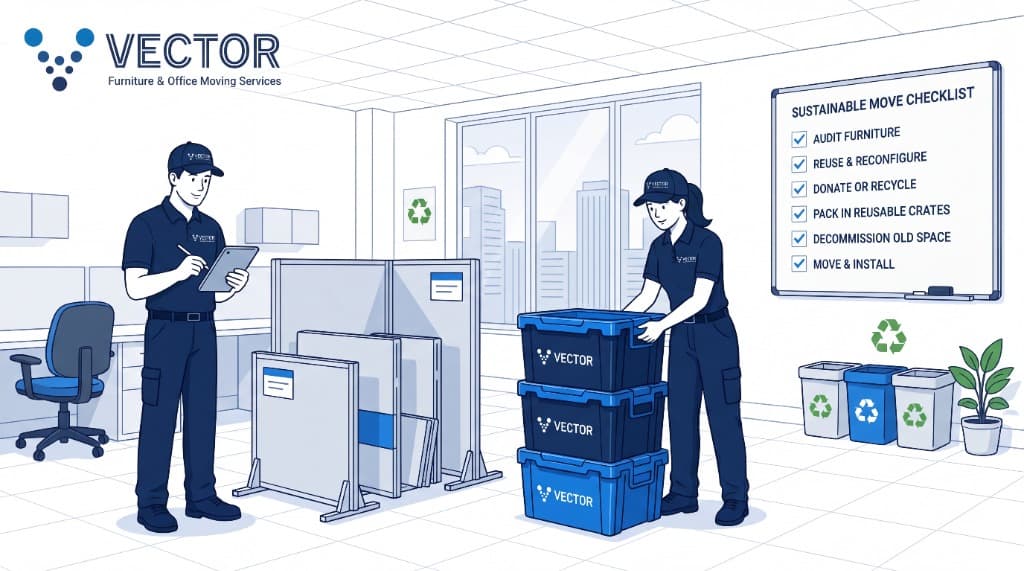
Quick Answer
A sustainable office relocation is a commercial office move planned to reduce landfill waste, reuse existing furniture where possible, recycle or donate unwanted assets, and coordinate responsible removal from the old space. For many businesses, the biggest opportunities are not in the moving truck itself. They are in the decisions made before the move: what to keep, what to reconfigure, what to donate, what to recycle, and what must be removed during office decommissioning.
For facility managers and operations teams, the goal is simple: move into the new office with less waste, fewer surprises, and a cleaner exit from the old space. Vector Installation Services helps Southern California businesses plan office moves, furniture installation, office decommissioning, and furniture removal as one connected project.
Why Sustainable Office Relocation Matters
Office moves create waste quickly. Old cubicles, filing cabinets, desks, chairs, monitors, cables, packaging materials, and broken furniture can pile up before anyone has a plan for them. When the schedule gets tight, usable assets often end up in dumpsters because there is no time left to sort, sell, donate, recycle, or reuse them.
A better move starts earlier. Before your company signs off on a moving date, you should know what is going to the new office, what can stay in use, what needs professional removal, and what your lease requires before you hand back the keys.
This approach can help your business:
Reduce landfill waste from furniture, packaging, and e-waste.
Lower unnecessary moving costs by moving fewer unwanted items.
Reuse existing cubicles, desks, and workstations when they still fit the plan.
Coordinate donation, recycling, liquidation, and disposal before the final week.
Avoid lease-return problems during office decommissioning.
Step 1: Audit Your Furniture Before You Move
The most useful sustainability decision is also the most practical one: do not move items your company does not need.
Start with a room-by-room furniture and equipment audit. Include workstations, private offices, conference rooms, storage rooms, server areas, breakrooms, and common spaces. For each item, decide whether it should be kept, reconfigured, donated, recycled, sold, or removed.
Use these categories:
Category |
What It Means |
Typical Examples |
|---|---|---|
Keep |
Move it to the new office |
Chairs, desks, conference tables, filing cabinets |
Reconfigure |
Reuse it in a new layout |
Cubicles, benching systems, modular panels |
Donate |
Give usable items to an approved recipient |
Chairs, desks, tables, storage units |
Recycle |
Break down materials responsibly |
Metal cabinets, damaged panels, wiring |
Remove |
Professionally clear it from the old space |
Unwanted systems furniture, broken furniture, debris |
If your company already owns modular workstations, do not assume they need to be replaced. A professional office reconfiguration team can often adjust the existing furniture system to fit a new floor plan. This can reduce purchasing, freight, packaging, and disposal waste.
Step 2: Decide What Can Be Reused in the New Office
Many companies treat relocation as a reason to buy everything new. Sometimes that makes sense. But in many commercial offices, existing furniture can still be valuable if it is disassembled, moved, and reinstalled correctly.
Before ordering new furniture, ask:
Do the existing workstations fit the new floor plan?
Can panels, desks, and storage components be reused?
Are replacement parts available?
Does the furniture still support the way the team works?
Would reconfiguration cost less than replacement?
This is where office furniture expertise matters. A general mover may only see furniture as items to carry. A commercial installation team can evaluate whether systems furniture can be reused, rebuilt, or combined with new components. Vector supports office furniture installation, cubicle installation, and reconfiguration for businesses that want to make better use of existing assets.
Step 3: Use Reusable Moving Crates Where Practical
Cardboard boxes are common, but they are not always the best choice for office moves. Reusable plastic moving crates can reduce cardboard waste, speed up packing, and protect documents, small office items, and workstation contents.
Reusable crates are typically delivered before the move, packed by employees or move crews, moved to the new office, and picked up after unpacking. They also reduce the need for packing tape and can help keep departments organized during the move.
For many office relocations, a mixed approach works best. Use crates for files, desk contents, and common office supplies. Use protective blankets, carts, and proper handling methods for furniture, equipment, and larger assets.
Vector also offers rent moving crates support for businesses that want a cleaner and more organized move process.
Step 4: Plan Office Decommissioning Early
Sustainability often breaks down at the old office. The new space gets most of the attention, but the old space still has to be cleared, cleaned, and returned according to the lease.
Office decommissioning can include:
Disassembling cubicles and workstations.
Removing unwanted furniture.
Clearing storage rooms and common areas.
Coordinating donation, recycling, or disposal.
Removing low-voltage cabling when required.
Preparing the space for lease return.
Do not wait until the final week to decide what happens to unwanted furniture. Donation pickups, recycling coordination, and removal schedules need time. If the timeline is compressed, the easiest option becomes disposal, even when better options were available earlier.
Step 5: Handle Cubicles and Systems Furniture Correctly
Cubicles are not simple trash. They are made from a mix of fabric, metal, laminate, plastic, electrical components, and hardware. Some systems can be reused. Some can be parted out. Some need to be separated for recycling or disposal.
If you are removing cubicles from the old office, work with a team that understands cubicle movers, cubicle installation, and commercial office furniture removal. Proper teardown reduces damage, improves reuse options, and keeps the job safer for everyone on site.
Step 6: Create a Responsible E-Waste and Cabling Plan
Old monitors, computers, phones, servers, network equipment, and cables should not be treated like ordinary trash. Many electronics require proper recycling, and some devices may require data handling before they leave your control.
For an office move, build a separate plan for:
IT disconnect and reconnect.
Server room equipment.
Monitors and workstations.
Phones and network hardware.
Old cabling that must be removed under the lease.
E-waste recycling and documentation.
Vector can coordinate commercial move planning with IT disconnect and reconnect and structured cabling needs so the physical move, furniture plan, and technology work do not fight each other.
Step 7: Choose a Move Partner That Can Manage More Than Trucks
A sustainable office relocation requires coordination. You need more than a crew that can load and unload. You need a partner that understands office furniture, decommissioning, removal, installation, and project timing.
When comparing vendors, ask:
Can they help audit what should move and what should not?
Do they understand commercial office furniture systems?
Can they support furniture removal and decommissioning?
Can they coordinate reusable crates or lower-waste packing methods?
Can they work after hours or over a weekend to reduce business disruption?
Will they help sequence the old-space exit and new-space setup?
Vector Installation Services supports office moving, project management, furniture installation, office decommissioning, and removal for commercial clients across Orange County, Los Angeles, the Inland Empire, San Diego, and nearby Southern California markets.
Sustainable Office Relocation Checklist
Use this checklist before your next commercial move:
Inventory furniture, equipment, storage areas, and IT assets.
Confirm what furniture is moving to the new office.
Identify items for reuse, donation, recycling, resale, or disposal.
Review the lease-return requirements for the old space.
Plan office decommissioning before the final week.
Decide whether reusable moving crates make sense.
Schedule cubicle teardown, furniture removal, and installation crews.
Coordinate IT disconnect, e-waste, and cabling needs.
Confirm elevator access, loading docks, building rules, and after-hours work.
Get a written scope so the move, installation, and decommissioning work are aligned.
FAQs About Sustainable Office Relocation
What is a sustainable office relocation?
A sustainable office relocation is a commercial move planned to reduce waste, reuse existing assets, and responsibly remove or recycle unwanted furniture, equipment, and materials. It includes planning for the new office and the old office at the same time.
How early should we start planning?
For a mid-sized office, start planning at least three to six months before the move. Larger offices, multi-floor relocations, or projects with major decommissioning needs should start earlier.
Can old office furniture be reused in a new office?
Yes, if the furniture is still in good condition and fits the new layout. Modular workstations, cubicles, desks, storage, and conference furniture can often be reconfigured or reinstalled instead of replaced.
What should we do with unwanted office furniture?
Unwanted office furniture should be sorted for reuse, donation, recycling, resale, or responsible disposal. A professional office furniture removal team can help determine the best path based on condition, timeline, and site requirements.
Are reusable moving crates better than cardboard boxes?
Reusable moving crates can reduce cardboard waste and make office packing more organized. They are especially useful for files, desk contents, and department supplies.
Who should manage the old office cleanout?
The old office cleanout should be managed by a team experienced in office decommissioning, furniture removal, and lease-return requirements. Waiting too long can increase costs and limit donation or recycling options.
Plan a Cleaner Office Move With Vector
A sustainable office relocation is not just about being greener. It is about planning better. When you know what to move, what to reuse, what to remove, and what the old space requires, the project becomes cleaner, faster, and easier to manage.
Vector Installation Services helps Southern California businesses plan and execute commercial office moves, furniture installation, decommissioning, cubicle services, and responsible office furniture removal.